
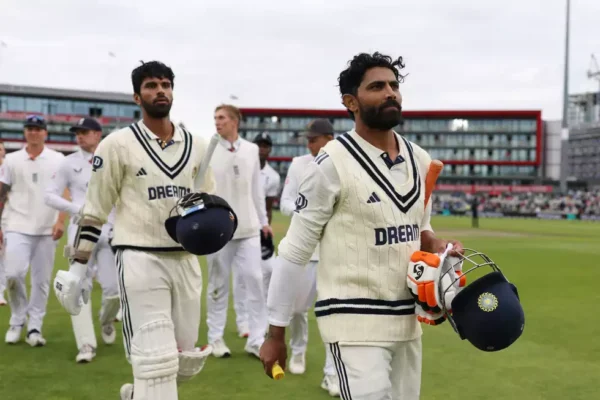
United in Manchester: Four batters, five sessions, one stand
Yeah, yeah, go, go, easy one.” Ravindra Jadeja’s voice cut through the post-lunch hum at Old Trafford. It wasn’t a one-off. Every time he or Washington Sundar nudged a ball into a gap, Jadeja called out, loud and clear, urging his partner to run, to push, to keep the scoreboard ticking. The tone was urgent but composed. In the moment, the word ‘easy’ made perfect sense. But nothing about the bigger picture was easy. It was the start of the second session – the fourth of five India needed to survive to save the Manchester Test, and the series. Shubman Gill had just fallen for a masterful 103, minutes before the interval. And India have had a complicated relationship with collapses and breaks this series. Behind Jadeja and Washington were Shardul Thakur, three No.11s, and a hobbling Rishabh Pant with a fractured toe. There wasn’t much room for optimism if another wicket fell. But Jadeja and Washington were giving it a go. This was the defining passage of play. The first session had brought 49 runs in 26 overs – a terrific show of resistance – but both leaders of that resistance, Gill and KL Rahul, had fallen after batting for 379 and 300 minutes respectively. In contrast, the eight overs after lunch yielded 37 runs. Suddenly, England had a moving target. The more runs India added and edged into a lead, the more time England would need to get them, and the less there’d be left in the match. The draw, once a faint hope, was now being dragged into the realm of possibility. And somehow, Jadeja and Washington made it real. India won’t win their first Test series in England since 2007. But they haven’t lost it either. At least, not yet. And after spending 157.1 overs in the field and collapsing to 0 for 2 in their second innings, they batted five sessions to keep ‘The Oval’ alive. Old Trafford’s pitch held firm through five days, but this was still a different kind of defiance – a kind of self-denial modern cricket rarely demands. Ten straight hours of stillness and stubbornness. The kind that bruises. The kind that tests the will and physicality as much as the technique. Manchester 2025 will stand as a marker, a placeholder for this era of India’s Test cricket, and of the demands this format will make of those who feature. Few passages captured that better than the partnerships between Jadeja and Washington, and Gill and Rahul, who between them batted 875 balls. Even their symmetry felt deliberate, maybe even poetic. In a match that ended with the timing of the handshake drawing scrutiny, this one featured a quiet handhold across generations.. Not long ago, Gill and Rahul were competing for the same Test spot. Washington is widely seen as Jadeja’s natural successor. And here they were in Manchester, two pairs from the present and the future, each enduring through two sessions. No clash. No contradiction. Just a shared belief: to save a Test, sometimes, you have to unlearn everything you know. You’d think Rahul and Jadeja, with their years in Test cricket, had done this before. But they hadn’t – not like this. Not with nothing to gain except the chance to not lose. Before today’s 107*, Jadeja’s highest second-innings score in a match-saving effort was 32*, also against England, in Rajkot, 2016. Rahul’s 149 at The Oval in 2018 came in a hit-out-and-hope knock, a match India lost at the end of a tour India they’d fluffed. Gill and Washington, despite their first-class credentials, are unmistakably products of a generation raised on white-ball instinct, where urgency is default, and cricket balls are treated like flies to be swatted. Rahul and Jadeja have survived that shift and thrived within it, but they also carry the rhythm of an older tempo – more methodical, more meditative. That entire range of conditioning had to come together. In the series opener at Headingley and again here at Old Trafford, India’s assistant coach Sitanshu Kotak distilled it into a mantra, delivered in his calming Gujarati twang: “Session by session.” One hour at a time. One spell at a time. And each hour on the final day offered its own test: of control, of courage, of concentration. The first belonged to the captains. Ben Stokes, held together by strapping and stubbornness, bowled through bicep strain and cramps, pouring everything he had into the battle. Across from him stood Gill – hit on the fingers, then on the helmet, both off the same ball that reared off a length. He didn’t want to switch helmets because the replacement felt different and could disrupt his flow. Even with his fingers still stinging, he had conviction to press forward to the next ball, delivered onto the same spot. The battle was no longer about shot-making. It was about thresholds: physical, mental, emotional. Gill stayed tactically alert too. He refused a single that would’ve taken him closer to his century, believing the left-hander Washington was more vulnerable to the rough Liam Dawson was targeting. That hundred, his fourth of the series and the slowest of his career, eventually came after he’d spent 36 balls in the nineties and was punctuated by a raw shout of “come on.” His dismissal, on the stroke of lunch, too wasn’t a post-milestone lapse. It showed the difficulty of playing for a draw, when you can get ahead of yourself after surviving one battle. In this case, Archer came on from the more benign Brian Statham End. On the fourth afternoon, counter attacking the new ball had worked well for Gill in taking off the shine from it. Only this delivery, set up for inswing, seamed away and kissed the edge. Four down and far away from safety, Jadeja walked out with a point to prove. He had four consecutive fifties but his defining image from the series was of him being wrapped in a hug by Stokes. At Lord’s on the final day he had…