
‘We don’t buy superstars, we make superstars’

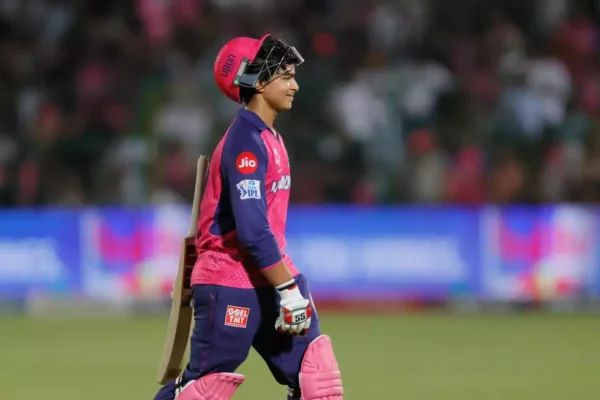
Over the years, Rajasthan Royals have been renowned to be a side that promotes and nurtures young talent. After winning the inaugural IPL season in 2008, RR hasn’t seen much success as a team, with their 2022 runners-up finish being the next best campaign for the franchise. Their 100-run defeat to MI on Thursday (May 1) officially knocked the Royals out of IPL 2025, which meant another season gone without a playoffs berth. Amidst all this, the one thing that keeps RR going is their constant endeavour to propel talented young players to the forefront, the 14-year-old Vaibhav Suryavanshi being the latest in the list. The Royals have received a lot of flak with their retention choices in recent times – Jos Buttler and Trent Boult being the notable names that RR let go – but fielding coach Dishant Yagnik doesn’t feel that the team has much concerns in the ongoing cycle and beyond. “Whenever a new player has entered our side over the years, they weren’t stars already,” Yagnik explained during the post-match press conference. “They became stars at our franchise. The current bunch, we’re confident that they will become stars, we’ll make them stars. We don’t buy superstars, we make superstars, that’s our tagline. “For example, take Vaibhav Suryavanshi, everyone was happy and emotional for him the way he batted. So, in the coming years, guys like him will become stars. “Time has come for us to look beyond such things (regretting not retaining players like Buttler). When we don’t have them, we have to forget and move on. Now we have Vaibhav, Yashasvi Jaiswal, Sanju Samson is our captain. We’ll go ahead with this side and we’ll prove our winning ability with this side.” Reflecting on the 2025 season, Yagnik lamented the Royals’ inability to execute their plans in crunch moments. It cost them dearly in three successive run chases and in hindsight, those were six valuable points gone down the drain. Against Delhi Capitals and Lucknow Super Giants, the equation was single digits going into the final over of the chase – a cakewalk by modern T20 standards. Yet, the DC game went into a Super Over where RR further lost the plot in plans and executions to come up short. Against LSG, the choke saga continued as the batters failed to close the game out. If it was Mitchell Starc in the first contest, it was Avesh Khan in the next game as RR’s campaign hit a roadblock. Against RCB, the equation had come down to 17 needed off 12 balls, another easy situation to be in but the Royals once again found ways to lose, eventually falling short by 11 runs. Yagnik admitted that his side could have done a lot better in those three fixtures. “If you look at most of the games, we were often close to winning those matches. In those crunch moments where execution is crucial, we probably fell short in close games and that’s how two points went away from us. As you know, we were dominating in those three games (against DC, LSG and RCB) but there was a shortage in execution during crunch moments. It happens in cricket.” Another aspect where RR lacked severely is in the fielding department. They were guilty of putting down too many catches, many of which proved critical in the overall context of the game. Against MI, there was more evidence of this as Suryakumar Yadav got multiple reprieves that he cashed in on with aplomb. Yagnik chose to look at this season’s errors as an anomaly and felt that fielding form does fluctuate in the sport. “I’ve been the fielding coach for eight years now. From 2018 to 2023 if you check the data, we were always in the top three (in terms of fielding). Once in a while, such a season comes when you miss a lot of catches in back-to-back games. It happens with all franchises. “In cricket, taking and missing catches are part and parcel of the game. Even today, three catches were missed. What matters is your level of preparation.” Yagnik was all praise for MI’s batting effort after the five-time champions had posted a huge total of 217 on a surface that wasn’t exactly a belter. To be fair, RR’s bowlers did execute their plans for most parts but were undone by some outstanding batting from the visitors. If Ryan Rickelton and Rohit Sharma set up the platform with their respective fifties, the work was carried forward by Suryakumar Yadav and Hardik Pandya as MI ended up with a daunting total on the board. Reflecting on his side’s bowling, Yagnik didn’t prefer to be too critical and instead, credited MI for putting up a fantastic show. “If someone’s skill proves to be a handful for your bowling plans, like Rohit’s skill set, Surya’s skill set. They batted well and hit sixes off really good balls. So, you have to credit Mumbai Indians’ batters for the way they batted, In the last game, GT conceded that Vaibhav played classy shots. Similarly, you need to credit MI for their batting.” On a night when dew didn’t show up, Royals’ decision to bowl at the toss looked like a blunder in hindsight. On a slow surface, batting didn’t get easier in the second half, as was the expectation from the home side. Given RR’s emphatic chase against GT, it wasn’t surprising to see them opt to bowl but the results backfired for them. Yagnik also defended RR’s decision to chase, citing the logical reasoning behind the move. “If you look at the previous games played at this venue, batting has always been easier to bat in the second innings. There is always the expectation of dew. With the weather being a bit overcast then (at the time of the toss), there was also the possibility of getting some swing early. So, keeping all these technical points in mind, we bowled first.”
Read More

Brilliant Suryavanshi makes a prodigal impression

It took all of one ball in the IPL for the 14-year-old Vaibhav Suryavanshi to reveal something essential about him. His lofted drive inside-out for a six was not only an announcement of his arrival in the big league but also a testament to his unfazed and fearless approach to batting, leaving no respect for the bowler irrespective of their reputation. The audacity under the lights was visible. But it was the question of who Suryavanshi was beyond the spectacle: in training sessions, around big, established cricketers who know their drills, habituated to the pressures and limelight, aware of what’s expected of them and what the opposition has to offer? Despite scoring a record century, the ‘too-young’ Suryavanshi wasn’t sent to explain his side of the story. On Monday, following the win against Gujarat Giants, Vikram Rathore, the batting coach of Rajasthan Royals, turned up to present his version instead. “He’s been exactly like what you’ve seen him on the pitch,” confessed Rathore. “He isn’t intimidated by anyone in the nets. He takes on Jofra, who is one of the toughest bowlers to face in the nets; awkward and quick. “But he really takes him on. Again.” Just as Rathore was completing his explanation, the lights and sound went off. Call it cosmic intervention if you must, but no one was, by design at least, taking the spotlight away from Suryavanshi on April 28, 2025. Ask Sai Sudarshan who bagged the Orange Cap. Ask Shubman Gill, who stroked another majestic half-century. Ask Jos Buttler, who sent a reminder about what Rajasthan Royals lost. Ask Yashasvi Jaiswal, who himself dazzled with an unbeaten half-century in a successful run chase. Under Jaipur’s floodlights, Suryavanshi, the boy from the “clan of the sun” lived up to the name, shining the brightest among all the stars. In pursuit of a target, which opponents Gujarat Titans believed was above par, Suryavanshi took little time to dictate the terms of the play, getting off the mark by despatching Mohammed Siraj for a 90-meter six over long on. He was unafraid to hit over the in-field even when obvious traps were laid out. Even though the blueprint to thrive on the Jaipur surface was already provided by Shubman Gill and Jos Buttler earlier in the game, en route their respective brisk half-centuries, Suryavanshi designed one of his own. As he unleashed his big bat-swing, not everything hit the middle of his bat. In fact by the time he had touched the half-century mark in the fifth over, 38 percent of his attempted shots were false strokes. Much of it didn’t matter. In the over preceding that, bowled by Ishant Sharma, two edges ran past the ropes and one over it. The edges that delivered those boundaries for Vaibhav were merely salt added to the wounds of the experienced pacer. Just a ball before he was lured to slash outside off, a delivery on his pads was nonchalantly flicked into the roof of the stands, with a no-look follow-up. Ishant went for 28 in that over. Washington went for 21 in the next. A couple of overs later, Prasidh was blasted for 17 and Karim Janat for 30. His record-breaking innings was replete with ample luck as it was with emphatic strokeplay. If we were to borrow Albert Greenfield’s theory, luck happens to the competent. While there were ample cuts and pulls that took the top edge, there were also many more unfazed pulls, thunderous drives, powerful flicks and audacious chips over the in-field which forced bowlers to alter their lines. Suryavanshi has the range, and the skills – both tested, and now displayed. To explain it in technical language, Sachin Tendulkar put down Suryavanshi’s success to his ‘fearless approach, bat speed, picking the length early, and the energy behind the ball.’ Rathore summed it up in two words: great downswing. Rathore testified that the Royals coaching staff wasn’t surprised by what Suryavanshi produced on Monday. They had seen enough evidence of that over the last four months. What impressed them was that he could do that at the biggest stage, against the best bowling attack of the tournament this season. On the surface, all of this seems like any other high-scoring IPL game of the Impact Player era, where the bowlers are hapless spectators to surfaces made for boundary fests, the kind of which has subdued the fascination of fast-scoring centuries. On the surface, Suryavanshi could be just another talented young cricketer joining the already long beeline of youngsters who continue to show the rich wealth of talent that resides in the near obscurity of Indian domestic cricket and deeper. Like Ayush Mhatre. Like Priyansh Arya. What makes this innings exceptional, though, according to Rathore, is that Suryavanshi is only 14 years old. That age indeed becomes significant to understand the magnitude of what played out on Monday evening at the Sawai Mansingh Stadium. To offer perspective, Ishant had started playing international cricket nearly four years before Suryavanshi was born. The context of age remains also critical in understanding why unlike many other blazing knocks played in the IPL, this one would especially be remembered. Not just because it’s the fastest IPL century by an Indian, and the second fastest ever in the history of the tournament, but because no one in any part of the world has registered a T20 century at an age younger than Suryavanshi’s 14 years and 32 days. That Suryavanshi has achieved something that no one his age anywhere in the world could, deepens the wonder. Turn age-agnostic and the story takes a different turn. Rathore, in his limited vocabulary, ran out of adjectives to explain Suryavanshi’s performance. Exceptional. Spectacular. Special. But in all extreme expressions offered to the innings, he was mindful to caution against going overboard with comparisons and expectations. “He’s just starting out,” Rathore warned. “He’s a special kid and a special talent. If he keeps working hard, he’ll go a long way.” As Mahendra Singh Dhoni, the…

Read More

Hurricanes end campaign with inconsequential win

Fifties from Matthew Wade (63 off 41) and Ben McDermott (50 off 35) along with an all-round show from Nathan Ellis (16 off 5 and 2-29) helped Hobart Hurricanes to eke out a narrow seven-run win over Melbourne Stars at the MCG on Monday (January 15). The Hurricanes openers were instrumental in their team getting an above-par total and the target of 188 proved to be far too many for the Stars despite the efforts of Beau Webster (55* off 43), Marcus Stoinis (48 off 32) and Glenn Maxwell (32 off 18). Put into bat, the Hurricanes got going through a fluent 86-run stand off 60 deliveries between Wade and McDermott. While the surface was better than the typical MCG deck, strokemaking still wasn’t as easy as it would be at a batting-friendly venue. Wade and McDermott started with a bang in the powerplay and then consolidated on the gains thereafter before being separated off the last ball before drinks. It was just the opening Stars needed as their spinners Daniel Lawrence (4-35) and Imad Wasim (2-35) inflicted a collapse. Macalister Wright and Tim David played short cameos but Hurricanes missed partnerships to carry the good work of their openers forward. Ellis’ heroics in the 20th over ensured that the visitors finished with a strong total. The chase didn’t begin well for the Stars who lost both their openers for not much on the board. It meant that their starry middle order had to do the bulk of the work. Webster stitched a 44-run stand off 31 balls with Maxwell to reignite the innings while a 80-run stand off 54 balls with Stoinis kept the chase going. However, it always seemed like the Hurricanes were marginally in front. Ellis followed up his cameo with a wily bowling display to choke the run flow. He picked timely breakthroughs and also bowled the tough overs to keep his side in front. With 32 needed off 12 balls, Ellis produced a brilliant penultimate over, conceding just eight runs to all but seal the result. Peter Hatzoglou did concede 16 off the final over but that included a six in the final delivery when the game was already done. Stars did well to stay in the chase but a target in excess of 185 was always going to be dicey at the MCG. Brief scores: Hobart Hurricanes 187/8 in 20 overs (Matthew Wade 63, Ben McDermott 50; Daniel Lawrence 4-35) beat Melbourne Stars 180/4 in 20 overs (Beau Webster 55*, Marcus Stoinis 48; Nathan Ellis 2-29) by seven runs

Read More