officialsquarexsports

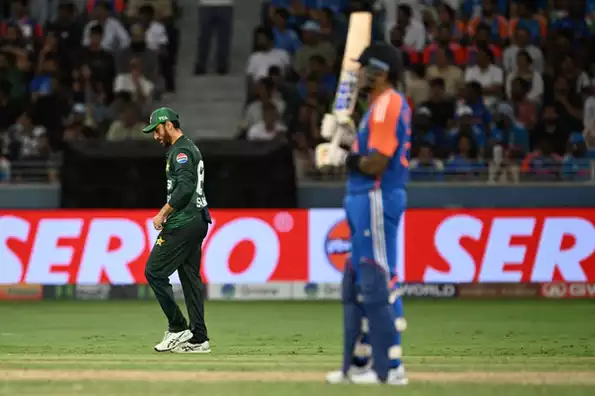
Imperfect India still too good for Pakistan

Perhaps nothing summed up the night better than Sahibzada Farhan’s dismissal. He was well set, past his half-century and had already taken on Jasprit Bumrah with rare success; only two batters have ever scored more against him in T20Is. At 90/2 at the halfway mark, Pakistan were flying. And then came the moment. Shivam Dube, hitting the deck with the slower ball he has been working on with Morne Morkel, and making Farhan reach out with his wide line. The shot was miscued, the bat flew out of his hands, and he was caught at cover. The dismissal told two stories. One, of Pakistan’s intent. They had been bruised by their 127/9 in the previous meeting and this was their answer: swing hard, play brave, push India. Fakhar Zaman swung hard too before a close call for caught-behind went in India’s favour. Saim Ayub broke out of his rut of zeroes with 21 off 17. Hussain Talat was promoted to keep the left-right combination intact. And Salman Ali Agha, who had averaged four against spin in this Asia Cup, demoted. Pakistan were hell bent on attacking, and for ten overs, it worked. The other story was how India recovered. Dube’s two wickets in 11 balls after the drinks break changed the rhythm. India bowled it slower, bowled it wider, kept Pakistan reaching and reaching until the mistakes came. It wasn’t a perfect night for India. Nowhere close. They dropped four catches, their most in a T20I in three years. Abhishek Sharma shelled two, both straightforward, while Kuldeep Yadav and Shubman Gill put down one each. Bumrah finished wicketless, leaking 45 off his four overs. Varun Chakaravarthy, so often the chokehold, also went wicketless for the first time in 12 T20Is, not helped by the drops off his bowling. And yet, Pakistan’s 171 felt about par, not beyond. That is the gap. Even when India’s best were blunted, others filled the spaces. Axar Patel, who turned up with a neck patch after hurting himself while fielding in Abu Dhabi, and barely bowled in warm-ups, ended up delivering just one over. Hardik Pandya didn’t even need to bowl four overs. And Dube, who has bowled out his full quota of overs only three times in 39 T20Is, stepped up on a much flatter pitch than last time and returned figures of 2 for 33, most of his deliveries banged on back-of-length. “According to me, Shivam Dube’s spell was a turning point for the game,” Suryakumar Yadav said. “I think he has been working really hard on his bowling in all the practice sessions. And this was the perfect game where he got an opportunity. He always wanted to bowl a minimum two overs and today he got to bowl his quota of all the overs. So he was very happy. And the way he delivered, I think he had very clear plans. And that’s what I want from the boys and that makes my job easier.” The gulf looked even wider in the chase. Shubman Gill and Abhishek Sharma, friends since under-12s, opened with a stand worth 105. It wasn’t their first hundred together, and won’t be their last, but it was a partnership that turned the match into a canter. Gill threaded cover-drives and even reverse-swept. Abhishek smashed the first ball out for a six again. Shaheen Afridi and Haris Rauf had words; Gill and Abhishek had words and plenty of shots. By the time the stand was broken, the writing was on the wall for Pakistan. “Both of them batted beautifully,” Suryakumar said of Abhishek and Gill. “It was required today to have a very good start and they gave it. “The way both of them bat… it’s like a fire and ice combination. They complement each other really well and that’s what I want to see. If someone is batting brilliantly, the other one can take a little backseat and just rotate the strike. “I think it’s really important to be very, very good friends off the field. If you are batting together, opening together, that really helps to get your bond a little stronger. Sometimes you don’t have to say anything on the field. You look in the eye and take that cheeky single… I think that friendship comes into picture when they both bat together.” For Pakistan, this was their best batting day of the tournament. For India, it was their worst fielding and worst bowling day of the tournament. And yet, the contest didn’t stretch. An imperfect India were still too good for Pakistan.

Read More

Oman’s big night, India’s quiet test

It was about 4:15 pm local when Jatinder Singh, Oman’s captain, walked towards the pitch at the center of the Sheikh Zayed Stadium. He wasn’t inspecting the playing surface. He was visualizing, with a bat in hand, what it would feel like to bat against the No. 1 side in the world. India weren’t even out on the ground until 20 minutes before the toss. Jatinder’s team had been there for hours, warming up, huddling often, building themselves up for the moment. Oman were playing India for the first time and everything about them suggested how eager they were for the occasion. Even before a ball was bowled, the day felt like it belonged to them. And by the end, it did. Not in terms of the result, but in how close they pushed India with the fraction of resources at their disposal, and turned the match into something it was never supposed to be: a contest. They may not have known what to expect from India, yet when the time came, Shah Faisal got his left-arm seam to come in like an offbreak and breach Shubman Gill’s defence. Jiten Ramanandi collected every ball driven back at him, a couple of them ricocheting onto the stumps for run-outs at the non-striker’s end. Aamir Kaleem and Zikria Islam stitched together a spell of 22 balls of spin that tied down Tilak Varma and Sanju Samson in the middle overs. And with the bat, Oman’s openers put on a stand of 56 runs. Aamir raised a fifty off 38 balls and Hammad Mirza followed with one off 30. For much of the night, Oman didn’t look out of the game and their wins showed in small moments. Like in the 17th over, when Suryakumar brought in mid-off and pushed back fine leg, suggesting to a well-set Aamir Kaleem that a short ball was on its way. Instead, Arshdeep Singh bowled a full delivery on the stumps, hoping for an lbw, only for the ball to be heaved through square leg for a boundary. But the “lack of experience and exposure” that Jatinder has spoken about during this Asia Cup was always lurking, waiting to catch up in the pressure of a tight chase. One wicket, courtesy Hardik Pandya’s superb running catch at fine leg in the 18th over, and suddenly India’s victory felt inevitable. But Oman had already made their point. And as their captain said after the match, “the boys are ready to roar” in the T20 World Cup qualifiers that will be played in Oman. India’s calls throughout the game suggested they wanted a workout before the Super Fours and they certainly got it. They rested the two bowlers who would have been the toughest to face for any new team: Jasprit Bumrah, with his pace, angles and aura; and Varun Chakaravarthy, with his legbreaks and googly that now come out of his hand with similar scramble. With the bat, everyone got a turn except Suryakumar Yadav. Maybe that was the point. India have been vocal about flexibility before the T20 World Cup, about how only the openers are locked in. So Samson came in at No. 3. India had played two matches without really knowing what he looked like as a non-opener, so this was his audition. But one would think that his sluggish fifty, the slowest of his T20I career, didn’t give many answers. Then it was Pandya, Axar Patel, Shivam Dube and Tilak Varma with the bat, and in that order. Even Harshit Rana, Arshdeep Singh and Kuldeep Yadav batted ahead of their captain. And while only Axar and Tilak got to face more than 10 balls, the other batters still got their precious few minutes in the middle, which they didn’t quite have the luxury of in India’s back-to-back dominant victories. On a sluggish pitch, India’s 188/8 was more impressive than it looked. Scoring this Asia Cup’s joint-highest team total even with so much self-imposed randomness at play showed how good Suryakumar Yadav’s team is. Come the second innings, Shivam Dube bowled; he hadn’t against Pakistan. Abhishek Sharma bowled; he hadn’t against UAE. Even Tilak Varma bowled; he hadn’t all Asia Cup. Arshdeep Singh and Harshit Rana bowled for the first time in this tournament. India used eight bowlers in all,the joint-most they have used in a T20I match; they had used six each against UAE and Pakistan. “I think it was very, very important for other guys to chip in and get a game under their belt,” T Dilip, India’s fielding coach, said. “Because we never know who can be used at what point of time. The key thing for us is to make sure that we get as many players as possible a game under their belt. Oman played well, and I’m glad that we held the nerves in the end better.” India clearly wanted to stretch themselves but not sure they would have liked how close this got in the end. But they got the workout they bargained for, and Oman their big moment under the sun.

Read More

For Kuldeep Yadav, it’s all about making the overs count

Mid-June in Beckenham, Kuldeep Yadav stood on the sidelines of India’s intra-squad practice game and squinted at the playing surface. He thought it looked good for spinners: dry, with just enough bite and some bounce to work with too. He said as much in an informal press meet. A five-Test series against England was about to begin, and with no Ravichandran Ashwin in the squad, Kuldeep seemed to have allowed himself a little hope. The pitches, when the series began, were exactly that: dry, flat, crying out for something wild. India had the wild thing, but he never got a game. It was not for lack of skill. Kuldeep had already reworked his bowling, straightened his run-up, made his rhythm more aggressive and stopped his hand from falling away. That journey of making himself a technically better, more sustainable bowler at the highest level was behind him. He had even won Tests at home with those changes, flipped series, showed the ability to deliver on demand even with Ashwin and Jadeja in the XI. But none of that was enough. Not when the question was balance. Balance, that old cricketing black box of selection. When injuries didn’t keep him out, Kuldeep lost his spot to someone who could bat. India now like their allrounders, their finger spinners who could defend the red ball better and hit the white ball longer, even if their ceiling with the ball was lower. Flat tracks may demand magic, but team sheets rarely do. That irony followed him to the Asia Cup. Few expected him to play here either. It was the start of the season, the pitches were fresh, unlike the tired track from the Champions Trophy earlier this year, and Shivam Dube was putting in the hours in the net session. To go with that, this Gautam Gambhir-coached side loves its allrounders. Kuldeep isn’t one. But they also love their spinners in limited-overs cricket, so in came Kuldeep at the cost of Arshdeep Singh. Two matches into this Asia Cup, he has six wickets in 24 balls. Player of the Match against UAE. Player of the Match against Pakistan. His last T20I before this? The World Cup final in Barbados. From the bench in England to the honours board in Dubai, this distance wasn’t covered in overs by Kuldeep. But time. And some of it must have been really frustrating. “It’s challenging when you’re not playing,” Kuldeep has said during this Asia Cup. “Rhythm is very important when you are playing your first game after a while. If you play regular games, your rhythm is set. You have an idea of bowling, how you are spending time in the field, how you are reacting on the field.” In the match against UAE though, Kuldeep’s first for India since the Champions Trophy final in March, the rhythm was a non-issue. He started with a tight over before unleashing hell in his next. Rahul Chopra chanced his arms at a flighted delivery and was caught in the deep. Muhammad Waseem, the captain, then swept and missed. Lbw. Harshit Kaushik, younger and overeager, lunged at a wider googly and was bowled. Three wickets in the space of an over, three different dismissals, and the full range of wrist spin at play. Against Pakistan, the field at one point of time told you the story. Slip, leg slip, silly mid-on, with Kuldeep on a hat-trick. Hasan Nawaz slogged and top-edged into Axar’s hands, and then, off the very next ball, Mohammad Nawaz trapped first ball by the googly. The ball had turned in too sharply, too quickly. He reviewed; three reds on the screen. Out. “I know Kuldeep was with the Test team,” his T20I captain Suryakumar Yadav said after the Pakistan match. “He couldn’t get an opportunity to play but he was working really hard on his fitness, on his bowling and you can see it. Two games in a row, he has won it for us.” Just like that, Kuldeep has six wickets already in the tournament. In fact, India have been so well-rounded, so much better that those around them that they have barely looked like needing his full quota of overs. Kuldeep, while picking his second PoTM award in this Asia Cup, insisted that he is still not bowling his best and that he’s been using “too many variations”. But the numbers are what they are. While his pace has been under 90kph more often than not, the variations of pace, the line of his googly and the energy on the ball has done the trick. Like Mike Hesson, the Pakistan coach, pointed out: India’s spin, well most of it, was not mystery, not magic, just pressure sustained until the mistake came. And the mistakes have come against Kuldeep plenty. That’s the thing with wrist spin. It is a wild art. It can go wrong. But then again, it can also go very right. Flat pitches demand it. India resisted it in England but they couldn’t in Dubai. And given the chance to be back in India colours, Kuldeep has made every over count, just as he thought he might back in Beckenham, staring at a pitch, waiting for his chance.

Read More

Pakistan lodge protest, call India ‘unsporting’ for not shaking hands

After India beat Pakistan by seven wickets in their Asia Cup fixture in Dubai, the post-match presentation was held up for several minutes. When it did take place after a short delay, Salman Ali Agha didn’t show up for it. India captain Suryakumar Yadav as well as Player-of-the-Match Kuldeep Yadav were in attendance though. “Team manager Naveed Cheema lodged a strong protest against Indian players’ behaviour of not shaking hands,” PCB said in a statement. “It was deemed as unsporting and against the spirit of the game. As a protest we did not send our captain to the post-match ceremony.” Earlier, in the press conference, Pakistan head coach Mike Hesson had called Agha’s absence a “flow-on” effect of India’s decision to not shake hands, both at the toss and after the match was completed. Cricbuzz understands that match referee Andy Pycroft reached out to Salman Agha at the toss, requesting him not to shake hands with his Indian counterpart Suryakumar. PCB is understood to be miffed with Pycroft’s approach but later changed tune, choosing not to name him in their press release. Sources from the Indian camp suggest that Suryakumar also did not shake hands with UAE captain Muhammad Waseem at the toss but both the teams did exchange handshakes after the match was done. Speaking about India’s stance at the post-match press conference, Suryakumar had said that “a few things in life are ahead of sportsman spirit” and that his team “gave a proper reply” to Pakistan.

Read More

Ibrahim, Atal, bowlers clip Pakistan’s wings

Ibrahim Zadran (65) and Sediqullah Atal (64) starred in Sharjah as Afghanistan beat Pakistan by 18 runs to go level on points with their neighbours in the tri-series in the UAE. A complete bowling performance also saw four Afghan bowlers pick up a brace to stifle their opponents in the chase. For Pakistan, Faheem Ashraf was their standout performer with 4 for 27 in his spell but the effort ended up in a losing cause. Having opted to bat, Rahmanullah Gurbaz went cheaply for just eight falling to the spin of Saim Ayub in the second over. The wicket brought Atal and Ibrahim together with the former playing an excellent lofted straight drive to the fence in the third over. Afghanistan were only 18 for 1 after 4 overs but Ibrahim took on the short deliveries by Haris Rauf to hit a four and a six off the speedster. Pakistan were slightly sloppy after this in the field. Atal played an inside-out shot that flew over the ropes before five runs off an overthrow meant that they got 15 runs off the seventh over. The duo brought up the 50-run partnership in the ninth over as Ibrahim comically swept Mohammad Nawaz for four over the umpire’s head straight down the ground. The Afghan duo found the boundary once in the next two overs but despite the flow of runs, Ayub was miserly with the ball conceding just 18 runs in his 4 overs. It was the 14th over which changed the complexion of the game. Having struggled to line up Sufiyaan Muqeem, the duo clinched three fours and a six in the massive 20-run over which also saw Atal bring up his second T20I 50. Atal fell to Ashraf, bringing an end to the 113-run stand, while Azmatullah Omarzai was dropped in the last ball of the same over. Ibrahim moved to 50 and then clinched three boundaries off Rauf who continued to be expensive. Ashraf struck twice in three deliveries in his second over with Omarzai and Ibrahim departing. The Pakistan all-rounder also claimed the wicket of Karim Janat before Mohammad Nabi smashed a four and a six to take Afghanistan to 169 for 5. AM Ghazanfar began proceedings on his T20I debut but Sahibzada Farhan slog-swept him for six. At the other end, though, Ayub fell first ball to Fazalhaq Farooqi. Fakhar Zaman came in and got his innings going with two boundaries in quick time. Farhan continued his blitz with a four and a six off Ghazanfar before he had his stumps castled by Farooqi. Salman Ali Agha and Zaman found the stands twice to take Pakistan to 52 for 2 at the end of the PowerPlay. Afghanistan missed a run-out chance off Zaman but to their fortune, the southpaw thick-edged one straight to the short third-man fielder. Agha was run-out in the next over as Pakistan’s innings was suddenly derailed. They never recovered from the stutter as Hasan Nawaz fell to Noor Ahmad while Nabi scalped Mohammad Haris. The onus fell on Mohammad Nawaz and Ashraf in the death overs but Rashid picked two-in-two to leave Pakistan eight-down. Noor scalped Ashraf which was the final nail in the coffin before Rauf’s lusty blows – he hit four sixes – at the end provided some entertainment for the crowd in the end. Brief Scores: Afghanistan 169/5 in 20 overs (Ibrahim Zadran 65, Sediqullah Atal 64; Faheem Ashraf 4-27, Saim Ayub 1-18) beat Pakistan 151/9 in 20 overs (Haris Rauf 34*, Fakhar Zaman 25; Noor Ahmad 2-20, Mohammad Nabi 2-20) by 18 runs

Read More

Oval Invincibles seal third straight Hundred title

Oval Invincibles have done the Hundred three-peat. On Sunday night, they wrapped up a hat-trick of Hundred titles with a 26-run victory over Trent Rockets, riding on Will Jacks’s blistering 72 and Nathan Sowter’s game-breaking spell (3-25). Having looked set to get close to 180, they stumbled at the death to finish on 168/5 and looked set to finish runners-up for the first time, but the bowlers stepped up to avoid that. Asked to bat, Invincibles got exactly the start they wanted. Jacks was off the blocks quickly, smashing seven fours and four sixes in a 41-ball stay that kept Rockets’ bowlers under constant pressure. Jordan Cox was breezy at the other end, with 40 off 28. The pair pushed their side forward after the early exit of Tawanda Muyeye. When Rehan Ahmed broke the partnership, it had been worth 87 runs, that came off 55 deliveries. Jacks was determined not to let that dismissal affect how the Invincibles finished, and he combined with Sam Curran to propel them further by taking 16 off a set from David Willey. However, they struggled to keep up against some effective death bowling as only 25 runs came off the last 20 deliveries, despite one set of five in that from Stoinis going for 15. In his previous set, Stoinis gave away just five runs, while Dillon Pennington and Ben Sanderson conceded just 1 and 4 respectively. Rockets went into the break perhaps as the happier side for the way their bowlers finished, hoping to ride that momentum in chase. Tom Banton started off by taking boundaries off Jason Beherendorff but Saqib Mahmood and Sam Curran bowled tight to keep Rockets to just 32/0 in the PowerPlay. The Invincibles went for spin from both ends in the middle and reaped dividends when Joe Root attempted to up the scoring against Sowter. The England batter found Jacks at long-on with his big hit which ended his scratchy stay of 10 from 13. Sowter bowled 10 deliveries in this set and struck two more times – cleaning up Rehan Ahmed and having Banton too caught at long-on to reduce the Rockets to 37/3. The urgent repair work from there came through an alliance between Willey and Stoinis. The Rockets had just 51/3 at the halfway stage but were starting to make quick progress through this new batting pair. Stoinis crunched two fours of Sowter and Willey went after Adam Zampa, only to fall after hitting a six. Much to the frustration of Stoinis, who still harboured hopes of pulling off the unthinkable, the lower order couldn’t quite stand tall with him in what remained of the chase. Ross Whiteley offered the most resistance while Stoinis counter-attacked during their 38-run partnership. The chase was in an unlikely territory for the Rockets with 78 needed off 25, but the pair attempted it. They took 10 off a set from Sam Curran and then hit three sixes off his brother Tom to narrow the equation down to 48 off 15. But Mahmood came back and ran Whiteley out, leaving Stoinis with the all to do. Sam Curran bowled three good deliveries in the penultimate set of the match, giving just three runs but Stoinis capped that off with a six and a four. Even with that, the ask was 33 off the last five, which was beyond the grasp of even Stoinis. Mahmood gave away no width and tied down the batters in the last set, completing the title win with Stoinis’s wicket on the last delivery for a valiant 64 off 38. Brief Scores: Oval Invincibles 168/5 in 100 balls (Will Jacks 72, Jordan Cox 40; Matt Carter 2/24) beat Trent Rockets 142/8 in 100 balls (Marcus Stoinis 64; Nathan Sowter 3/25, Saqib Mahmood 2/22) by 26 runs © Cricbuzz

Read More

Ravichandran Ashwin retires from IPL

Ravichandran Ashwin has called time on his IPL career. The spin veteran announced his decision on X, and hinted at playing franchise cricket around the world. “They say every ending will have a new start, my time as an IPL cricketer comes to a close today, but my time as an explorer of the game around various leagues begins today,” Ashwin posted on X. Ashwin had a grand homecoming this year after Chennai Super Kings bought him for INR 9.75 Crore. But he endured an underwhelming season, playing just nine matches where he picked seven wickets. Earlier this month, Cricbuzz had reported that Ashwin and CSK were set to part ways. The 38-year-old offspinner, who debuted in the league back in 2009 with CSK, went on to feature in 221 matches across multiple franchises, taking 187 wickets. He walks away as the fifth-highest wicket-taker in the IPL, having featured in 16 of the 18 seasons. Ashwin was a vital part of CSK’s title wins in 2010 and 2011, picking 13 and 20 wickets respectively. In 2010, Ashwin was also the player of the series in CSK’s Champions League T20 victory. In the next year’s IPL final, he famously bowled the first over and dismissed Chris Gayle for a duck in RCB’s chase of CSK’s 205/5. He won a second Champions League T20 trophy with CSK in 2014. After a long successful stint at his home franchise, Ashwin went on to ply his trade at the now-defunct Rising Pune Supergiant, Punjab Kings – who he captained, Delhi Capitals and Rajasthan Royals. From making his debut in 2009 to the 2015 season, Ashwin played for CSK, picking 90 wickets in all. In 2016, when CSK served a ban, he turned out for RPS, also under MS Dhoni. He then missed the 2017 season through injury. In 2018, Punjab Kings fought off Rajasthan Royals to prise him away for INR 7.60 crore, and handed him captaincy. Even as he picked 25 wickets across those two seasons, Punjab’s fortunes didn’t change as they finished well outside of the top four on both occasions. Before the 2020 season, he was traded to Delhi Capitals, where he played for two years. In the mega auction of 2022, Rajasthan Royals bagged him for INR 5 crore, where he formed a lethal spin attack with Yuzvendra Chahal. He picked 12 and 14 wickets in the first two seasons at RR before facing a slight dip in 2024 [9 wickets at an economy rate of 8.49]. RR then released him and CSK swooped him in for big money.

Read More

Australia’s Mackay mayhem in numbers ft. Head, Green and Connolly

Stats highlights from the 3rd ODI between Australia vs South Africa in Mackay 431/2 is Australia’s second-highest ODI total, behind the 434/4 in Johannesburg in 2006, and also the second-highest ever against South Africa. It is also Australia’s highest ODI total on home soil, surpassing the 417/6 against Afghanistan at the WACA during the 2015 World Cup, and the second-highest score by any team while losing two or fewer wickets, behind South Africa’s 439/2 against West Indies in Johannesburg in 2015. Highest totals for Australia in ODIs Total Opponent Venue Year 434/4 South Africa Johannesburg 2006 431/2 South Africa Mackay 2025* 417/6 Afghanistan WACA 2015 399/8 Netherlands Delhi 2023 392/8 South Africa Bloemfontein 2023 18 sixes by Australia in their innings is the most they have hit in a home ODI, bettering the 14 against Afghanistan at the WACA in the 2015 World Cup. Overall, it is their fourth-most in an ODI innings, with the record being 20 against New Zealand in Dharamshala in the 2023 World Cup. It is also the second-most sixes hit by any team against South Africa, after England’s 19 in Kimberley in 2023. 8 sixes by Cameron Green is the second-most for Australia against South Africa, behind Ricky Ponting’s 9 in Johannesburg in 2006. 276-run win is Australia’s second-biggest victory margin in ODIs, behind the 309-run win over the Netherlands in Delhi at the 2023 World Cup. Overall, it is the sixth-largest win in ODI history. The previous highest margin for Australia on home soil was 275 runs against Afghanistan in the 2015 World Cup. It is also South Africa’s heaviest ODI defeat, surpassing their 243-run loss to India at Eden Gardens in the 2023 World Cup. Biggest win margin in ODI cricket (by runs) Margin Team Opponent Venue Year 317 India Sri Lanka Trivandrum 2023 309 Australia Netherlands Delhi 2023 304 Zimbabwe USA Harare 2023 302 India Sri Lanka Wankhede 2023 290 New Zealand Ireland Aberdeen 2008 276 Australia South Africa Mackay 2025* 47-ball hundred by Cameron Green is the second-fastest for Australia in ODIs, only behind Glenn Maxwell’s 40-ball century against the Netherlands in Delhi at the 2023 World Cup. It is also the fastest century against South Africa in ODIs, bettering Matthew Hayden’s 66-ball effort at Basseterre in the 2007 World Cup. Fastest ODI hundreds for Australia (by balls faced) Balls taken Player Against Venue, Year 40 Glenn Maxwell Netherlands Delhi, 2023 47 Cameron Green South Africa Mackay, 2025* 51 Glenn Maxwell Sri Lanka Sydney, 2015 57 James Faulkner India Bengaluru, 2013 59 Travis Head New Zealand Dharamsala, 2023 5th instance of three hundreds in an ODI innings and the second where each of the top three batters reached the landmark. Head (142), Marsh (100) and Green (118*) became the first Australian trio to score centuries in the same ODI innings. It is also the second instance of a team producing three hundreds and a fifty in one innings. Overall, this is the sixth time all of Australia’s top four made 50-plus scores, and the second such instance against South Africa. Three players scoring 100s for a team in an ODI innings Cam Green smashed Australia’s second-fastest ODI ton. ©AFP 250-run opening stand between Travis Head and Mitchell Marsh is the fifth-highest for Australia in ODIs, topped by the 284 between Head and Warner against Pakistan in Adelaide in 2017. It is also the highest opening partnership against South Africa, surpassing the 200 by Vikram Solanki and Marcus Trescothick for England at The Oval in 2003, and the third-highest for any wicket against South Africa. This is the third time Head has featured in a 250-plus stand, the joint-second most by a player alongside Sachin Tendulkar and Sourav Ganguly, with only David Warner ahead on five. The 250 run stand between Head-Marsh and 164* by Green-Carey also marked the first time Australia recorded two 150-plus partnerships in the same ODI innings, the 10th such instance overall. 250-plus run opening partnership for Australia in ODIs Highest partnership against South Africa in ODIs Part of most 250-plus partnerships in ODIs 142 runs by Travis Head is the third-highest individual score for Australia against South Africa, behind David Warner’s 173 in Cape Town in 2016 and Ricky Ponting’s 164 in Johannesburg in 2006. It is also the eighth time both Australian openers have scored centuries in the same ODI innings, and the third such instance against South Africa. Highest scores for AUS vs SA in ODIs 12.14 run rate in the 164-run third-wicket stand between Cameron Green and Alex Carey is the highest for Australia in partnerships of 150-plus. The previous best was 11.7 by Glenn Maxwell and Shane Watson, who added 160 off 82 balls against Sri Lanka in Sydney during the 2015 World Cup. At 22 years and 2 days, Cooper Connolly became the youngest Australian to take a five-wicket haul in ODIs, surpassing Craig McDermott (22y 204d) against Pakistan in Lahore in 1987. His 5/22 are now the best bowling figures by an Australian spinner in ODIs, bettering Brad Hogg’s 5/32 against West Indies at the MCG in 2005. Connolly is also the first Australian spinner to take a five-for against South Africa in ODIs, and only the second Australian left-arm finger spinner with a five-wicket haul, alongside Michael Clarke (5/35) against Sri Lanka in Dambulla in 2004.

Read More

Cheteshwar Pujara: A master in stillness

There was always a sense of stillness to Cheteshwar Pujara. Not the stillness of inaction, but of intent. At the crease for over a decade, he seemed less a man fighting bowlers and more one negotiating with time. Every leave, every block, every push past point was a reminder from him that Test cricket, at its essence, was not about how quickly you can conquer it, but how long you can endure. Pujara’s numbers in Tests read: 176 innings, 7195 runs, 43.61 average, 19 centuries. But the essence of his storied career lives elsewhere. It lives in long afternoons he forced bowlers to bowl, in the miles he added to their tired legs, in bowling intensities he so expertly blunted and many times, in the floor he left open for the next man in to seize. In the museum of his long career, two Australia tours sit pretty as the mantlepiece. Adelaide 2018 was classic Pujara. India were 86 for 5, Australia sharpening their claws on the first morning of a long tour. Then they ran into the human form of defiance, who set up shop for 376 minutes (or 6+ hours), carving a century out of uncertainty. That innings gave India a foothold to win their first-ever Test series in Australia. Pujara brought a delectable gumption for grit, and it consumed Australia whole. A century in Melbourne and 193 in Sydney – innings that seemed to grow roots in the middle of the pitch – wrapped it up. Two years later in Brisbane, he played one of the most unusual great knocks. His 72 in the fourth innings chase came against a bowling pack that was meaner, particularly to him, in their desperation to not concede defeat at a citadel. He took body blows from Starc, Cummins and Hazlewood – blows that rang around the Gabba in anticipation of a surrender that never came. Instead, one of India’s greatest away Test wins transpired, built on this unflinching defiance. Harsher England conditions presented bigger challenges, and it showed in his inferior average there, but he still left marks that endure. In the first innings of the Southampton Test of 2018, there was daylight between his six-hour vigil worth 132 and the next best effort – Virat Kohli’s 46. Pujara’s appetite for the grind seemed sharper on home soil. In Ahmedabad, 2012, he gave England bowlers the kind of ordeal that lingers in memory long after – more than 500 minutes of watching their plans turned to mincemeat by a batter who resemebled a brick wall that refused to shift. Every passing minute and hour was another reminder that a contest with Pujara often lasted as long as he wished it to. He dead-batted and frustrated even on raging turners and against the best in the world. In Bengaluru 2017, Pujara’s second-innings 92 set India up for a series equaliser after a shocker in Pune just a week before. A week later, Australia were left in a daze, sending down 525 balls to him in a single innings. Watch him closely and you’d conclude Pujara’s batting wasn’t about aesthetics. It was about effectiveness, and erosion. Pujara eroded bowlers, their plans, their time. His were innings of smaller wins – an extra over forced, and a spell dragged beyond comfort to the point where bowlers looked a yard or two slower by the end of a harrowing evening. As the career prolonged, there were criticisms too. That he was too slow. That he put pressure on the other batters. That his strike-rate belonged to a different era. And yet, some of these qualities transformed India into a team that could put up a fight anywhere in the world. His ways, his wearing down of the opposition, bought space for Kohli to flourish, for Rahane to counterattack and Pant to be his adventurous self. For years, he proved to be the scaffolding without which the structure of the Indian Test team would’ve been shaky. India chose to move on from him after the World Test Championship final of 2023 – a year where his average dipped to 25. A peculiar phase when technique, his biggest ally through the years started to behave like a cold acquaintance. It robbed him of the core of his being as a cricketer – of time in the middle. But he pushed back, like only he knew, and continued soldiering on for Saurashtra in Ranji Trophy and Sussex in County cricket deep into the twilight of his career. Ultimately, Pujara didn’t fill Dravid’s shoes, but stitched his own. His legacy is not just in the truckload of runs he made, but also in the resolute desire to occupy the crease for hours on end, in extolling virtues of putting a heavy price on his wicket and in standing out as an old-fashioned red-ball cricketer in a white-ball infested landscape. And, in making batting tenacity sexy again.

Read More

India cleared for Asia Cup participation, but no bilateral cricket with Pakistan

The Government of India has drawn a firm distinction between bilateral and multilateral cricketing ties with Pakistan, making it clear that the national team will participate in the upcoming Asia Cup despite the growing clamour for boycott and withdrawal. But there will continue to be no bilateral engagement with Pakistan. “India’s approach to sports events involving Pakistan reflects its overall policy in dealing with that country,” the Ministry of Sports and Youth Affairs said in a statement on Thursday (August 20). “So far as bilateral sports events in each other’s country are concerned, Indian teams will not be participating in competitions in Pakistan. Nor will we permit Pakistani teams to play in India. With regard to international and multilateral events, in India or abroad, we are guided by the practices of international sports bodies and the interests of our own sportspersons.” The clamour to ‘boycott Pakistan and the Asia Cup’ grew louder after the BCCI announced the 15-man India squad on Tuesday. The precedent had been set after the Legends tournament in England earlier this summer, when the India Champions pulled out of both their group fixture and semi-final against Pakistan Champions. Sponsors like EaseMyTrip also withdrew support, and the episode reignited the debate around whether India should completely avoid playing Pakistan. By drawing a clear line between bilateral and multilateral engagements, the ministry has paved the way for Indian teams to compete in global tournaments that also feature Pakistan, including ICC and ACC competitions. It also ensures that Pakistani teams will be able to participate in such multilateral events when hosted in India. Even the visa processes for the players and match officials is set to be relaxed as India look to push forward their bid of hosting the Olympics. “To position India as a preferred destination for hosting international sporting events, the visa process for sportspersons, team officials, technical personnel, and office-bearers of International Sports Governing Bodies shall be simplified,” the statement further said. “In respect of office-bearers of International Sports Governing Bodies, a multi-entry visa shall be granted on priority basis for the duration of their official tenure, subject to a maximum period of five years. “It is also relevant to take into account India’s emergence as a credible venue to host international sports events. Accordingly, Indian teams and individual players will take part in international events that also have teams or players from Pakistan. Similarly, Pakistani players and teams will be able to participate in such multilateral events hosted by India.” The government’s stand should clear the uncertainty over the Asia Cup and India’s participation in the matches against Pakistan in the eight-nation continental championship, scheduled from September 9 to 28 in the UAE.

Read More