Stats: Mandhana magic hands England Women their heaviest T20I defeat

Powered by a blistering Smriti Mandhana hundred and Shree Charani’s debut heroics, India Women defeated England Women in the first of five T20Is, at Trent Bridge on Saturday (June 28). Here are all the key numbers from the game: 2 – Smriti Mandhana became just the second India batter to register a hundred in Women’s T20Is, after Harmanpreet Kaur (103) did that against New Zealand at Providence during the Women’s T20 World Cup 2018. Mandhana’s 112 is now the highest individual score for India in the format, and the second-best against England after Meg Lanning’s 133* at Chelmsford in 2019. 18 boundaries hit by Mandhana on Saturday (15 fours and three sixes) is the most for India in a single innings, surpassing 15 (seven fours and eight sixes) by Harmanpreet during her aforementioned 103. 5 – Mandhana became the fifth female cricketer to register a hundred in each of the three formats in international cricket, joining Heather Knight, Tammy Beaumont, Laura Wolvaardt and Beth Mooney in an elite list. 8 – Mandhana now has eight fifty-plus scores against England, the joint second-most for a player against an opponent in Women’s T20Is alongside as many for Sophie Devine against South Africa and Beth Mooney against England. Mooney leads this record with nine 50-plus scores against India. 21 – Mandhana and Shafali Verma now have 21 50-plus stands between them, the most for any pair for any wicket in Women’s T20Is, surpassing 20 between Alyssa Healy and Mooney. Mandhana and Verma are just seven runs shy of going ahead of the Healy-Mooney pair’s overall aggregate of 2720. 5 – Mandhana was involved in two 50-plus stands: 71 for the first wicket with Shafali and 94 for the second with Harleen Deol. It was the fifth time that India had 50-plus stands for the first two wickets in a Women’s T20I, and the first such instance for any team against England. 97 runs– The defeat margin for England is their highest in a Women’s T20I by runs, four more than the 93-run defeat against Australia at Chelmsford in 2019. It was also the fourth highest victory margin for India Women in the format. Their previous biggest win against England was by 30 runs at the Bandra Kurla Complex, Mumbai in 2010. Biggest win-margins for India (by runs) Margin Opponent Venue, Year 142 runs Malaysia-W Kuala Lumpur, 2018 104 runs UAE-W Sylhet, 2022 100 runs Barbados-W Edgbaston, 2022 97 runs England-W Trent Bridge, 2025 84 runs West Indies-W Gros Islet, 2019 1 – India became the first full-member team to register back-to-back 200-plus totals in Women’s T20Is, having amassed 217/4 in their previous outing against the West Indies Women at the DY Patil in December 2024. That remains their highest T20I total, followed by 210/5 on Saturday and 201/5 against UAE-Women in the Asia Cup last year. It was also the third 200-plus total against England, after Australia’s 226/3 (Chelmsford, 2019) and 209/4 (Brabourne, 2018) respectively. 113/1 – India scored 113/1 at 12.55 in Overs 7-15 of their innings, the second-most for any team in that phase in a Women’s T20I featuring a full-member side, after West Indies’ 115/0 against Australia at the North Sydney Oval in 2023 (where data is available). India’s 111/1 against Malaysia Women at Hangzhou 2023 is third on this list. 178 – Mandhana (112) and Nat Sciver-Brunt (66) totalled 178 runs between them, making it the the second-highest aggregate for the two captains in a Women’s T20I featuring at least one full-member side, after 182 (Suzie Bates – 124*, Dane van Niekerk – 58) in the NZ-W vs SA-W contest at Taunton in 2018. 13.12 – England spinners returned 1/105 in eight overs at an economy rate of 13.12, the worst ever in an innings featuring at least six overs of spin. On the contrary, India spinners bagged 8/72 in 10.5 overs between them at an economy of 6.64. 4/12 – Shree Charani became the second Indian bowler to bag a four-fer on Women’s T20I debut, after Sravanthi Naidu had done so (4/9 in three overs) against Bangladesh Women at Cox’s Bazar in 2014.
Read More

ICC tweaks PowerPlay rules for shortened T20Is

The International Cricket Council (ICC) has introduced changes to the Playing Conditions in Twenty20 Internationals and the key point of alternation is in the PowerPlay calculations. To be more specific, the length of the powerplay will now be rounded to the nearest ball, instead of to the nearest over. As per the existing regulations, the first six overs are PowerPlay overs and they broadly constitute the 30 per cent of the permitted 20 overs. If the length of the innings is shortened, rounding to the nearest over can make a big difference. In circumstances when the number of overs of the batting team is reduced, the number of Powerplay overs shall be reduced in accordance with the table below. For the sake of clarity, it should be noted that the table shall apply to both the 1st and 2nd innings of the match. Match reduced (overs) Powerplay overs 5 1.3 6 1.5 7 2.1 8 2.2 9 2.4 10 3 11 3.2 12 3.4 13 3.5 14 4.1 15 4.3 16 4.5 17 5.1 18 5.2 19 5.4 Previously, an 8-over innings would contain two powerplay overs and a 9-over innings would have 3 powerplay overs. Now, as seen in the table above, the powerplay will instead end after 2.2 and 2.4 overs respectively. This keeps the proportion much closer to 30%. “This table has been used in the T20 Blast in England for many years, where ending a powerplay midway through an over has caused no difficulty for players or officials. It has now been accepted by the ICC Men’s Cricket Committee as the preferred method moving forward,” the ICC told the members. “In the 8 over example above, the umpire will make the signal after 2 balls of the 3rd over, at which point three further fielders are able to drop back from within the circle.” Concussion Replacements The ICC had previously advised the members that concussion replacements in Men’s T20I matches must be identified and named before the match has started. This has been introduced to make it an even playing field between the participating teams by removing the home team advantage of a larger pool of players available. The preferred requirement is to nominate and name the following concussion replacements before the match to the match referee: One wicketkeeper, One batter, One seam bowler, One spin bowler, One all-rounder The ICC said, “It is understood that Associate Member teams playing T20I matches may find it difficult to identify a minimum of five specific concussion replacement players for every match. This will particularly apply to the team playing overseas who will be restricted by the number of players available outside of the play; the system we have adopted for Associate Member T20Is will cater for this.” It went on to clarify, “Teams may nominate a batter as the replacement wicketkeeper. In these circumstances, however, the referee (or their replacement) may determine that the nominated batter must keep wicket if he is used as the replacement wicketkeeper. Alternatively, the referee (or their replacement) may allow another player in the starting XI to keep wicket instead of the nominated replacement, which is the current Law, but that is entirely at the (referees) discretion and will not be guaranteed. The purpose is a like-for-like replacement, not to try to gain an advantage with another batter.” Teams can nominate the same player for more than one category. “For example, the ICC says, “If an all-rounder is nominated for more than one position, and replaces a batter, the referee will likely restrict him from bowling as he is a batter replacement. There has never been a requirement for the concussion replacement to be restricted to the playing squad and that still applies. Teams can nominate anyone who is eligible/qualified to play for them. “The over-riding principle of a like-for-like concussion replacement still applies, and the (referee) responsible for it will deal with replacements based on the circumstances at the time. The (referee) will always have the discretion to determine if a replacement player is a near enough like-for-like to the injured player.” There are examples: For the home team: It will be easier for the home team to nominate 5 specific replacement players as they can nominate from outside of the squad selected for the match. It means that every home player in the country who is eligible to play can be nominated as a concussion replacement. If this proves difficult at any time, remember that the same player can be nominated more than once. For the away team: There are normally 14 players in a touring squad, and it is unlikely that there are any other players outside of the touring squad that are eligible and available for nomination where the team is playing. Under these circumstances the team should nominate the 3 players not in the playing XI on the form, with two of them nominated twice. If a replacement is required, it will be dealt with at the time based on the principle of a like-for-like replacement from the nominations. If there are eligible players outside of the squad who are available in the country where the team is playing, they can be considered as nominations. “Under exceptional circumstances the match referee (or their replacement) may consider a replacement player who is outside of the nominated replacements submitted by the team for the match. This is covered in the nomination form. Saliva on the Ball The ICC says, “If any substance, including saliva, is used to change the condition of the ball, it is mandatory for the ball to be replaced. Circumstances could arise whereby a team wants to change the ball and deliberately applies saliva to get it replaced. This new clause can prevent the ball from being automatically changed under these circumstances.” These changes apply only to the Men’s playing conditions. Women’s playing conditions will be updated in October, the ICC said. The new playing conditions will come into effect from July 10, 2025.

Read More

Pooran announces shock international retirement at 29

Dynamic West Indies batter Nicholas Pooran has sprung a surprise by quitting international cricket at the age of 29. Pooran is West Indies’ most-capped player in T20Is and their leading run-getter in the format as well. His retirement will come as a massive jolt for a side that’s been looking to make its way back up, especially in white-ball cricket after having missed out on qualification for the 2023 ODI World Cup. Pooran is at the peak of his powers in T20 cricket and had hit the most number of sixes (170) in the format last year. In the just-concluded IPL, Pooran managed to breach 500 runs in a season for the first time and smashed 40 sixes – the most in this year’s tournament. The 29-year-old was not picked for the ongoing tour to England and Ireland after he had requested Cricket West Indies for a break. Having never played Test matches for West Indies, Pooran made his debut in a T20I in September 2016. The ODI debut came in February 2019 but he hasn’t played the format ever since West Indies failed to secure a spot in the 2023 World Cup. Pooran has also captained West Indies full-time in limited-overs internationals in 2022 but won just 8 games out of 30 across both formats. West Indies’ first-round exit in the 2022 T20 World Cup in Australia prompted him to step down as the leader. West Indies will now have a massive hole to fill in that middle order with just eight months remaining for the next T20 World Cup. “This game we love has given and will continue to give so much – joy, purpose, unforgettable memories, and a chance to represent the people of the West Indies,” Pooran wrote in his statement on Instagram. “Wearing that maroon, standing for the anthem, and giving everything I had each time I stepped on the field… it’s hard to put into words what that truly means to me. To have led the team as captain is a privilege I will always hold close to my heart. “Though this international chapter of my career closes, my love for West Indies cricket will never fade. I wish the team and the region nothing but success and strength for the road ahead.” Cricket West Indies (CWI) said in a statement: “Nicholas officially informed the leadership of his decision to retire from international cricket, bringing to a close a significant chapter in his career. “A world-class player and a game changer, Nicholas leaves the game as the most capped West Indian in T20 Internationals with 106 matches and the leading T20I run scorer with 2,275 runs. His performances on the field and influence within the team have made a lasting impact on West Indies cricket.”

Read More

IPL poetic justice for Virat Kohli, finally

Is there a case for comparison between Virat Kohli and Lionel Messi? The Argentine won nearly every major football trophy at both club and individual levels – multiple Champions League titles, multiple Ballon d’Ors, multiple domestic league crowns, and even a continental triumph with Argentina. But for years, the FIFA World Cup remained the elusive piece of silverware – until the 2022 FIFA World Cup happened. Kohli’s case was similar but presented a kind of reverse vacuum. He had won it all – the ICC U-19 World Cup in 2008, the ODI World Cup in 2011, Champions Trophies in 2013 and 2025, multiple Asia Cups, the ICC Test Mace (for three consecutive years), and the T20 World Cup in 2024. One trophy, though, continued to elude him – the IPL. That was only till Tuesday night. That gap too was filled, just as Messi completed his legacy journey in 2022. “For him it’s all about winning games for RCB,” said Mike Hesson, hailing Kohli for his passion, longevity, intensity and loyalty. Kohli is one of the four players active since the IPL’s inception in 2008 – MS Dhoni, Rohit Sharma and Manish Pandey being the other three – and the only one to have stayed with the same franchise for all 18 seasons. Even Dhoni and Rohit do not have that distinction. The IPL glory is poetic justice. “I for one am absolutely delighted for him. I don’t think anyone deserved it more for the amount he’s given and the dedication and the patience, I guess the patience and commitment to RCB to keep pushing to win that first title. So there was a real desire, hunger and genuineness about it. So yeah, I watched it from afar and egged on RCB. I’m as happy as anyone,” Hesson stated. Most runs in the IPL (8661, leads the second placed batter by more than 1500 runs), most 500-plus runs (eight) in an IPL edition, third most IPL caps (267), 10 appearances in the IPL play-offs, four final appearances, most hundreds (eight), most fifties (63), maximum runs in a season (973 in 2016) and most fours (771) – few players are more deserving of the IPL honours. After his 43 in the final versus Punjab Kings, Kohli has taken his runs tally to 657 runs, third highest of the season. “Look, when I think about Virat, I talk about the intensity that he brings from a team perspective,” Hesson, who worked with Kohli for three years at RCB as coach, remarked. “And that to me, along with the fact he’s had five seasons of 600-plus runs… they dictate the outcome of the games.” One of the most extraordinary aspects of Kohli is his evolution – he has stayed relevant to the league from Season 1 in 2008 to Season 18 in 2025 even as the cricket itself, more so T20 cricket, kept changing. “He’s evolved with the game. So the fact the game pace has changed, scores are higher, he hasn’t got lost in that. You know, he’s actually just, he’s just pushed himself and he’s got better and you know, strike rates have improved.” Every new generation is known to bat faster than the previous one – like Dhoni and Rohit batting faster than Sachin, Jaiswal batting faster than Rohit and now the likes of Vaibhav Suryavanshi and Ayush Mhatre bat faster than Jaiswal. Even as the new generations started dominating, Kohli kept evolving and kept bucking the trend and kept staying relevant to the team’s cause. His strike rate over the last two seasons is higher than his career strike rate. He is like an avalanche, says R Sridhar, a former India fielding coach, who has worked with him for eight years. “What stands out most about Virat are his passion, longevity, and unwavering intensity. Even after 18 years, he brings the same fire, the same impact, and the same fierce commitment that marked his debut season. His intensity becomes even more evident when compared to others who’ve been around since the early years – it simply hasn’t dimmed. And Virat’s influence extends well beyond RCB. His dedication to fitness and discipline has inspired others across teams to adopt similar regimens. He’s like an avalanche – starting small, but eventually growing into a towering force.” Virat Kohli has never shied away from speaking out about the heartbreak of 2016. Recently he dwelt on the dual setbacks of the season – losing to the West Indies in the T20 World Cup semifinal and loss in the IPL final to SunRisers Hyderabad. “It took me a few days to get over the WT20 loss, because I was in such a position that I thought I could do it for India,” he said and recalled how everything was set up for their IPL celebrations that season. “Yes, I understand why 2016 still stings for him. We needed just 69 runs from 44 balls with nine wickets in hand with Kohli still batting. Everything was in place – a theme party had been arranged, a victory caravan was lined up, fan celebrations were planned. And then, suddenly, it all slipped away. We had Virat, Chris Gayle, AB de Villiers, Shane Watson, KL Rahul. That was a golden opportunity,” Bharat Arun, a former India bowling coach who was part of the RCB support staff that season recalled. “I’m certain he’s spoken in the dressing room, maybe even in the pre-match huddle. With 18 seasons under his belt – remarkably, all with the same franchise – he brings unparalleled continuity and experience,” Arun continued. “Is he desperate? I’m not so sure. After all, he’s already won everything else there is. An IPL trophy would be the icing on the cake – not just for him, but for the loyal RCB fans who’ve stood by him all these years.” Same was the view of Sanjay Bangar, who has worked with Kohli in different stages for about 10 years. “There was perhaps more desire than desperation. For…

Read More

Pressure-proof MI’s mastery of the moments

There was a stillness about the Gujarat Titans dugout. Sai Sudharsan was in the middle of lifting the early weight of impending doom caused by Shubman Gill’s first-over exit but they were still all on the edge of their seats. Gill plonked himself front and centre of the space, his pads still on 10 overs in. Ashish Nehra wasn’t patrolling the boundary line. He instead sat on the side, chatting away with performance analyst Sandeep Raju. The IPL trophy, placed just a little away from the dugout, glistened in the night sky as Sherfane Rutherford indulged in some shadow practice around it. In the middle, Sudharsan brought his monk-like approach to the team’s biggest game of the season. His Tamil Nadu teammate Washington Sundar caught on and GT’s percentage cricket was working at that point to keep MI on their toes. Right at the halfway stage, Hardik Pandya had a big decision on his hands. Just four days ago, he defended his call to bring in Ashwani Kumar instead of Karn Sharma as the impact substitute in Lucknow where MI lost to PBKS. On Friday night too, the toss up was between Ashwani’s medium pace or the leg spin – of Raghu Sharma. The initial plan, as Mahela Jayawardene later revealed, was for MI to get spin on and use the grip on the surface and the longer side of the boundary to trap the batters. They however, did not anticipate the heavy dew that turned up. Once again, in came Ashwani with the idea to try and nail yorkers. At 130/2 in 12 overs, GT were still not ahead of the curve in chase of MI’s 228/5. Their resolve still triggered a few mini-conferences between Hardik and Suryakumar Yadav, that involved talking tactics and doing some heavy towel work on the ball. But knowing two of the remaining eight overs belonged to Jasprit Bumrah, Sudharsan and Washington had to speed up before the death to give themselves a real chance in chase. The potential game-breaker came in the 13th over. As the wet ball kept skidding through, Trent Boult’s pace variations didn’t stick. Sundar saw through them and hit two successive sixes. Under pressure, the left-armer attempted a bluff. He pulled his long-off fielder in and sent square leg to the boundary to set up a short-ball ruse but went full. Sundar, batting deep in his crease, was in a position to dig it out and get another boundary down the ground in an 18-run over. It brought Nehra to his feet and the equation to 81 off 7 overs. Then came a brief pause followed by a Bumrah-fuelled flip to the proceedings. Sudharsan and Washington had scored 53 runs off the previous four overs, but there was a break before they could try and dig into the fifth. Suryakumar received medical attention to his back and left leg, while Bumrah and Hardik indulged in a discussion. When the play was ready to resume, Bumrah floored Washington with a nasty yorker, leaving the batter down on his face. Sudharsan later revealed that the stoppage did not affect their rhythm as he and Washington anticipated it and stuck to focussing on what they had to do next. But the wicket gave Bumrah and MI an opening that they tore down at the death. Walking alongside his experienced teammates was 23-year-old Ashwani Kumar, tasked with bowling two crucial overs under intense pressure – and was perhaps marked as a target because of it. Yet, he delivered outstanding nine-run overs, repeatedly hitting a full length outside the off-stump as Hardik placed boundary riders on the leg-side and packed the inner ring on the off.

Read More

T Dilip set to return as India fielding coach, handed one-year extension

T Dilip, the former fielding coach of the India Men’s team, is all set to rejoin the national setup. Cricbuzz understands that the Hyderabad-based coach, who previously served under Rahul Dravid and later for close to a year under Gautam Gambhir, has been offered a one-year temporary extension. He will accompany the Indian team on their tour of England next month. Dilip’s contract was initially set to run until May, and it was widely presumed that the Board of Control for Cricket in India (BCCI) would not renew it. In fact, he, Abhishek Nayar, and a few other members of the support staff were clearly told by a BCCI official that they would be relieved of their duties following the expiry of their contracts. Those coaches were known to be close to Rohit Sharma. With Gautam Gambhir reportedly setting himself up to play a more influential role in the Indian team setup, it was said that the head coach preferred a compact and pruned support staff. As a result, batting coach Abhishek Nayar and fielding coach T Dilip were relieved of their duties along with a couple other members of the coaching staff. However, it is now understood that Rohit Sharma has convinced both the BCCI and Gautam Gambhir to retain T Dilip as fielding coach. While Nayar – also known to be close to Rohit – chose to step down and take up his role with Kolkata Knight Riders, Dilip’s case was different. Sources say Rohit, despite announcing his retirement from Test cricket, personally requested Gambhir to retain Dilip. Ryan ten Doeschate, who was initially expected to replace him, will remain as an assistant coach. Meanwhile, the India A team, along with a few members of the Test squad, has arrived in England. Except for Akash Deep, all players have checked into the team hotel in Kent. Akash Deep is expected to join the squad within the next couple of days, well ahead of the first unofficial Test between India A and England Lions, scheduled from May 30 to June 2 in Canterbury. The main Indian Test squad is set to depart from Mumbai on June 6.

Read More

The winds of change at Punjab Kings

In the late hours of April 12, Shreyas Iyer fielded questions from the expert panel of the broadcasters on what had just happened. “It makes me laugh…” offered the Punjab Kings captain, after his side failed to defend 245 in Hyderabad. This was just their fifth game of the season, too soon to be an inflexion point for the worse after a bright start. But, stranger things have happened in this league, more dramatic trajectories forged after one morale-draining defeat. Punjab Kings were equipped with an environment to quickly move on, helped in part by the short turnaround time in their IPL schedule. But the next big hurdle shook them up almost immediately. At the halfway stage against KKR in Chandigarh three days later, they had a mere 111 runs to defend. All the batting positives, highlighted in the dressing room post the SRH-fixture, disappeared without a trace. But the bowlers swooped in to save the day, giving the team a performance for the ages. “I have coached a lot of games in the IPL and that might just be about the best win I ever had,” said the man who walked into a setup devoid of direction and flipped it around in his maiden attempt. Since winning his first IPL title as head coach with Mumbai Indians in 2015, Ricky Ponting has been drawn to potential restoration projects in the tournament. In 2018, he rocked up at Delhi Daredevils – the erstwhile name for Delhi Capitals – and declared that he was there to win the title. The opposite transpired that season as Delhi finished eighth but the following cycle was by far Delhi’s best. They got progressively better, ending at third, second and first on the points table in 2019, 2020 and 2021 respectively, with the second of those seasons even earning them a runners-up medal. The bonds forged during this tenure with a young but intuitive captain Shreyas paved the way for a reunion in 2025. Punjab Kings entered the mega auction in November with the fattest purse of INR 110.5 crore, and had the option of bringing either of his two captains at Delhi – Shreyas or Rishabh Pant, who led DC from 2021 onwards in Shreyas’ injury-hit absence. In Ponting’s mind, the choice was clear. “I was pretty keen to work with him [Shreyas] again,” Ponting said. “It was pretty obvious [from] how much money I was willing to spend on him at the auction. We had a great working relationship in Delhi, we made a final [IPL 2020] in Delhi under his captaincy. “I’ve known him as a person and as a player for a long time. He’s a quality person and when you’ve got quality people around your team, when you’re trying to make a difference and you’re trying to change culture, that’s what you need. If you spoke to the players individually, I think every single one of them would give Shreyas a great rap because he has spent a lot of time with them,” he added. With the power of hindsight, the brainstrust at PBKS can celebrate their win that predates the season – of bringing in a coach who has commanded authority everywhere he’s gone and a captain of his choice – fresh off title wins in the Syed Mushtaq Ali Trophy, IPL and T20 World Cup in 2024. Here too, Ponting started out with the big talk – the intent to build the greatest-ever Punjab team in the IPL, and his flamboyant skipper has shown gumption to match that in every step of the way. Granted, the bar is low to pull that off at Punjab Kings, a team that has repeatedly loitered in the mid to lower strata of the points table since a solo final appearance in 2014. But the standards set this season have been sky high, and consistently so. Chennai Super Kings of 2023 were the earliest to change their batting ways to adapt to the impact substitute era, and Sunrisers Hyderabad of 2024 latched on and took it forward. The 2025 iteration of PBKS has stormed that party with young, uninhibited batters in tow. All through the season, the PBKS players and the coaching staff have spoken about freedom, but maximising such an environment begins with first putting together the right ingredients. Once Ponting was in the building, the auction and retention decisions reflected his ideas straightaway. They took the tough call of letting Ashutosh Sharma go in favour of two other uncapped retentions in Shashank Singh and Prabhsimran Singh, but made up for it with more inspired uncapped signings. Priyansh Arya having multiple suitors wasn’t a surprise – he’d lit up the Delhi T20 league with 36 runs in an over, two centuries and a season tally of 605 in 10 innings at a strike rate close to 200. PBKS trusted him to bring the same swagger at a level above in the IPL and went the distance. Nehal Wadhera was another such acquisition, chomping at the bit for a breakthrough season after the opportunities earned at Mumbai Indians in 2023 and 2024. Over the last two months, these four – two openers, one middle-order batter and a finisher – have brought PBKS’ expansive batting plans to life. PBKS’ fab (uncapped) four of IPL 2025 Batter Innings Runs SR Prabhsimran Singh 14 499 165.78 Priyansh Arya 14 424 183.53 Nehal Wadhera 12 298 152.04 Shashank Singh 11 284 149.46 **Numbers until the end of league stage PBKS have also been blessed with Shreyas levelling up with the bat after a middling season in 2024 by his standards. 2025 is already his best ever, where he has been an all-phase tormentor. Shreyas has struck at 148.38 in the PowerPlay, 164.57 in the middle-overs and 216.12 at the death. Shreyas Iyer in IPL 2024 and 2025 Season Matches Runs SR 4s/6s IPL 2024 15 351 146.86 34/14 IPL 2025 14 514 171.91 38/31 This top-order has turned a side in perpetual distress into a fun,…

Read More

Sweeps in tow, Suryakumar Yadav conquers the final frontier

To say Suryakumar Yadav is amongst the best batters in T20s is stating the obvious. But even for a T20 batter as exceptional as Suryakumar, there exists a chink in the armour. Most batters’ scoring rate dips when they come up against bowlers who can turn the ball away from him and in Suryakumar’s case it is basically facing left-arm orthodox and legbreak bowlers. This season he has resorted to his super strength to top the challenge – the sweep shot and the use of angles to manipulate the field. Since the start of IPL 2018, only twice has Suryakumar managed to score at 140+ strike rate in a season against left-arm orthodox and legbreak bowlers combined – 2023 and 2025. The four spinners that got the better of him the most in this period belonged to one of the two types mentioned above – Yuzvendra Chahal (52 balls, 64 runs, three dismissals), Ravi Bishnoi (32 balls, 39 runs, three dismissals), Ravindra Jadeja (37 balls, 34 runs, two dismissals), and Mitchell Santner (six balls, five runs, two dismissals) – the last one being his team mate this time around. Suryakumar Yadav vs LA orthodox + legbreak in IPL Season Runs Balls Dis Ave SR Bnd% 6s 2018 92 72 3 30.66 127.77 15.27 3 2019 118 107 4 29.50 110.28 10.28 2 2020 134 101 3 44.66 132.67 15.84 2 2021 78 67 5 15.60 116.41 14.92 1 2022 87 74 3 29.00 117.56 13.51 3 2023 183 115 2 91.50 159.13 22.60 4 2024 48 40 1 48.00 120.00 12.50 1 2025 210 126 1 210.00 166.66 24.60 9 He arrived in IPL 2025 with little form behind him, averaging under 15 in the five preceding months, and in the season opener at Chepauk, the opposition tied him down with away spin. But by the time he faced them again in the first game of the second round of fixtures, Suryakumar worked his way to some form spending valuable time in the middle and he came up against old foe in Jadeja right away. Of the fourth ball he faced from the bowler, Suryakumar knelt down, put his front foot across and got inside the line of the ball to slog sweep him over square leg – the first time he cleared the ropes of Jadeja’s bowling in IPL. The first ball next over, he repeated the shot but placed it slightly towards right of where the previous six was hit. When Jadeja adjusted his lines further wide, Suryakumar swept him hard well in front of square to pick up another boundary. 11 balls. Two fours. Two sixes. 24 runs. Jadeja – check. Against Noor Ahmad, who dismissed him in the reverse fixture with a wrong one turning away from over the wicket, Suryakumar was even more severe sweeping him in the arc from 180-degrees behind the wicket to wide mid-on and hitting him for five boundaries in the night. Ravi Shastri, the former India head coach under whom Suryakumar made his international debut, explained the batter’s methods on air during the innings against CSK, “the reason why Surya is so good with the sweep shot is that if you watch him closely he is anticipating the pace of the bowler and then the planting of that front foot. When he wants to go fine he gets across with that front leg outside off-stump. When he wants to go square, the front is middle and leg stump line to get that angle right and hit the ball in that area.” Mumbai Indians were starting to gather some momentum in the tournament after a slow start and up next in the way was Bishnoi. In the return fixture in Lucknow earlier in the season which Mumbai lost, Suryakumar had hit Bishnoi for 24 off the 13 balls faced hitting him for four boundaries, all behind square. At Wankhede, Bishnoi was introduced to the attack when Suryakumar came in and he slog swept the first ball from the leggie for a maximum over mid-wicket. He pitched one shorter and was met with the same result. Like Jadeja, Bishnoi also went wider outside off the next ball to take it outside the batter’s hitting arch and was responded with a hard sweep along the ground for a boundary to the right of deep square leg. Two innings. 21 balls. Six fours. Two sixes. 47 runs. Bishnoi – check. In all, Suryakumar has faced 126 balls from left-arm orthodox and legbreak bowlers this IPL and scored 210 runs at a strike rate of 166.66, getting out just once – the average and strike-rate both highest for him in any season and so is the number of sixes hit (9). He has employed sweeps against them almost every third ball – 41 out of 126 – and he has hit them for boundaries every other ball (14 fours & six sixes). The reason behind the numbers he is having this season is that he has not been restricted to being a one-trick pony. In the must win game against Delhi Capitals on a slow wicket with appreciable turn against two quality wrist spinners in Kuldeep Yadav and Vipraj Nigam, Suryakumar showed exceptional restraint shelving his repertoire of sweep shots and instead chose to play in front of the wicket largely. He scored at a run-a-ball against spin in the innings, and laid into the seamers instead, smashing them for 59 off 29 balls at a rate of almost two runs a ball. Only 10 batters have scored more runs than Suryakumar against spin in an IPL season of which one, Glenn Maxwell in 2014, has managed to do it at a better strike-rate. No batter in a season of IPL has scored more runs of sweep shorts or its variants as much as Suryakumar has scored in IPL 2025. 39 of these runs were scored in the fine leg area, 58 in the backward square leg area, and 42 in the forward square…

Read More

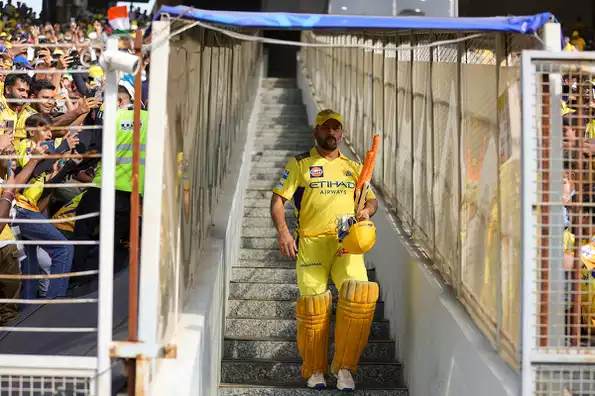
MS Dhoni to take time to decide on his future

MS Dhoni has said that he will take time before making a decision on his future. The 43-year old led CSK to victory in their last outing in IPL 2025 in Ahmedabad but did not give a definitive answer to a question about what the future holds for him as a player. “It depends, you know. Again, I would say the same thing. I have 4-5 months to decide. There is no hurry to decide,” said Dhoni in the post-match presentation ceremony. “Every year, it’s 15% more effort. To keep the body fit. Not to forget this is top level cricket. It’s professional cricket. You have to be at your best,” he added. “It’s not always performance that you can count. Because if cricketers start retiring because of performances, few of them will retire when they are 22. So what is important is to see how much hunger you have. What kind of fitness you have. And how much you can contribute to the team. Whether the team needs you or not.” “So [I] have enough time and go back to Ranchi. I haven’t been home for a long time…enjoy a few bike rides… [take a] couple of months then decide,” quipped Dhoni. When asked further on the decision, Dhoni re-iterated that he hadn’t made a decision one way or another. “I am not saying I am done. I am not saying I am coming back here at the same time,” he said. “As I said, I have the luxury of timing. When you have the luxury, why not? Think about it and then you can decide.” In IPL 2025, Dhoni was the oldest player of the season. He also had to step in midway to captain CSK after an injury to Ruturaj Gaikwad. He led them to three out of their four wins and six defeats. As a batter, he managed 196 runs in 13 innings coming lower down the order with a highest score of 30.

Read More

Expected consistency in rule changes: KKR write to BCCI

The IPL’s move to amend the playing conditions mid-season has not enthused a section of the franchises and Cricbuzz understands concerns have been raised with the Board of Control for Cricket in India (BCCI). After the BCCI announced the addition of 60 minutes of extra time to the match duration, at least one team has put the displeasure on record. “While these mid-season changes to the rules may be necessary under the circumstances, one would have expected more consistency in the way such changes are being applied,” Venky Mysore, the CEO of Kolkata Knight Riders, said in an email to Hemang Amin, the COO of the IPL. The KKR official’s contention was that if such an extension was made earlier, their match against Royal Challengers Bengaluru on May 17 may not have necessarily suffered a washout. He felt the extra time may have permitted a five-over game. “When the IPL re-started (on May 17), it was clear that the first game on May 17 KKR vs RCB was at high risk of being interrupted due to rain in B’lore. The forecast was there for all to see. Not only was the game washed out, but the additional 120 minutes now being applied may have provided a chance of at least a 5 over a side game (sic).” After the washout, the Knight Riders were knocked out of the race for a playoffs berth. Currently they are in sixth position with 12 points from 13 games and the maximum they can reach is 14 points. For the record, two of their games have been washed out this season. “The washout ended KKR’s chances of making the playoffs. Such ad hoc decisions and inconsistencies of applying them are not appropriate for a tournament of this standing,” Mysore said, adding, “I am sure you also understand why we feel aggrieved.” The KKR stand is not an isolated one and a few other teams this website spoke to also feel that the change of rules mid-season is not appropriate. The general impression is that it would set a wrong precedent. After its Governing Council meeting on Tuesday, the BCCI added one extra hour to the playing conditions 13.7.3 stating that “several matches are at risk of being affected by rain.” The rule change has been introduced with immediate effect. There are eight of the 70 league matches left in the tournament. According to the updated rule, a match scheduled to start at 7:30 PM can now begin as late as 9:30 PM without any overs being deducted. Under the earlier provision of just one hour of extra time, overs would have been reduced if play hadn’t started by 8:30 PM. Counting backwards, the cut-off time now allows for a five-over match to begin close to midnight.

Read More