
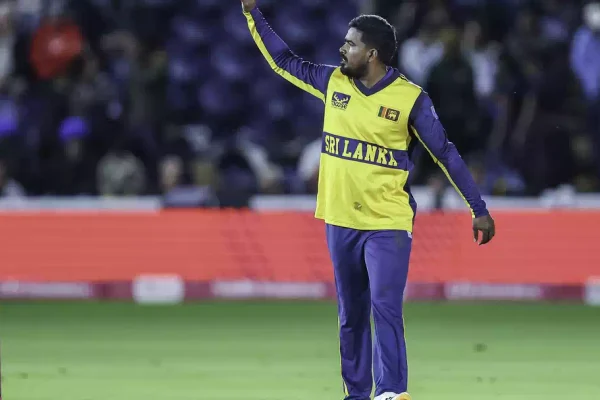
Ratnayake, bowlers secure bronze medal for Sri Lanka

In a game dictated by bowlers, Tharindu Ratnayake’s counter-attacking 65 became a big difference as Sri Lanka downed Bangladesh to secure the bronze medal at the Asian Games 2026. Sri Lanka were in dire straits at 54 for 5 in the 11th over when Ratnayake and Sahan Arachchige combined forces for a blazing 93-run stand. It powered Sri Lanka to 165/9 after which Bangladesh were bundled out for 102, with Ratnayake among four bowlers to pick two wickets each. Sri Lanka had the winds knocked out of their sails early after Arachchige chose to bat in the medal fixture. Mahedi and Aliss Al Islam wiped out the top four inside the Powerplay, leaving them at 21/4 in the fourth over. Ashen Bandara and Arachchige arrested the slide briefly to take the team past 50 and the Powerplay. But Rishad Hossain dismissed Bandara to reduce Sri Lanka to 54/5 in the 11th over. Then came the whirlwind partnership – 93 off 44 – between Ratnayake and Arachchige, with the former smashing 65 of it. The Sri Lankan captain enjoyed the best seat in the house as Ratnayake’s essay came off just 35 balls and included seven fours and five sixes. The stand flew off the blocks with a 25-run over off Mustafizur Rahman and followed that up by picking 16 off Rishad. Sri Lanka took 61 off the last five overs, which included a 21-run over from Rishad to complete Sri Lanka’s recovery. As it turned out, their total was well beyond Bangladesh’s reach as they too suffered a batting implosion. Bangladesh’s top-three – Saif Hasan, Tanzid Hasan and Litton Das, all fell for ducks as Bangladesh were down to 4/3 in the third over. Towhid Hridoy became Ratnayake’s second wicket in the Powerplay as Bangladesh fell to 18/4 in the fourth over. Parvez Hossain and Yasir Ali dragged the team past the Powerplay but they couldn’t consolidate in the middle overs. Vijayakanth Viyaskanth broke the stand with Parvez’s wicket and triggered another collapse. Bangladesh went from 50/5 to 72/8 in the space of 18 deliveries, the chase now well beyond their reach. Sri Lanka’s bowling quartet of Ratnayake (2-18), Nuwan Thushara (2-18), Vijayakanth Viyaskanth (2-26), Wanuja Sahan (2-17) did all of the damage as Bangladesh were bowled out for 102 – 63 short of their target. Brief Scores: Sri Lanka 165/9 in 20 overs (Tharindu Ratnayake 65; Mahedi Hasan 2-19, Saif Hasan 2-28) beat Bangladesh 102 in 17.3 overs (Nasum Ahmed 26; Nuwan Thushara 2-18, Tharindu Ratnayake 2-18, Vijayakanth Viyaskanth 2-26, Wanuja Sahan 2-17) by 63 runs

Read More

Algerian Boxer with Male XY Chromosomes Advances to Women\’s Semifinals in Paris Olympics 2024

BIG BREAKING NEWS: Algerian boxer Imane Khelif, a boxer with male XY chromosomes, now defeats Hungarian Female Boxer Anna Luca in the women\’s 66kg boxing quarter-final. Imane is now assured of a medal at the Paris Olympics. SHOCKING everyone, International Olympic Committee has allowed boxer with male XY chromosomes to participate in women\’s event in Paris. The IOC\’s Controversial Decision: Fairness vs. Inclusivity The International Olympic Committee\’s (IOC) decision to allow Khelif to compete in the women\’s category has been met with a mix of shock, concern, and support. Critics argue that permitting an athlete with XY chromosomes to participate in women\’s events could compromise the fairness of the competition. They point to biological and physical differences traditionally associated with male and female bodies, especially in high-performance sports where even slight advantages can be decisive. The core of the controversy lies in the perceived physical advantages that may arise from differences in muscle mass, bone density, and hormonal profiles influenced by male chromosomes and testosterone levels. In combat sports like boxing, these factors are especially significant, raising concerns about the integrity of women\’s competitions and the potential impact on female athletes\’ participation. The IOC\’s Evolving Guidelines and Future Implications: The IOC has been tasked with the difficult challenge of balancing these perspectives, ensuring fair competition while fostering inclusivity. In recent years, the committee has updated its guidelines to allow transgender athletes to compete in categories aligned with their gender identity, provided they meet specific criteria related to hormone levels. However, these guidelines remain contentious, with ongoing debates about their effectiveness in maintaining a fair playing field. As Khelif progresses in the competition, her participation continues to provoke discussions about the broader implications for the future of sports. Her case highlights the need for ongoing dialogue and careful consideration of policies affecting athletes with diverse gender identities. It also underscores the complexities involved in creating a sports environment that is both inclusive and fair. The Debate: Balancing Fair Play and Gender Identity: Opponents of the IOC\’s decision fear that allowing athletes with male chromosomes to compete in women\’s categories could set a precedent that undermines the level playing field essential to competitive sports. Some athletes and sports professionals worry that this could deter female athletes from participating, knowing they might face competitors with significant physiological advantages. On the other hand, supporters of Khelif\’s inclusion emphasize the importance of recognizing and respecting gender identity, advocating for sports to be inclusive and accommodating of athletes who do not fit traditional gender categories. They argue that sports organizations must evolve and adapt to the complexities of gender and identity in the modern world, prioritizing inclusivity alongside fairness. A Turning Point in the Gender and Sports Debate: Imane Khelif\’s journey at the Paris Olympics serves as a microcosm of the larger debate surrounding gender, biology, and fairness in sports. Whether seen as a pioneering step toward inclusivity or a controversial decision challenging traditional competition norms, her participation is undeniably significant. The outcome of this debate will likely influence how sports organizations globally approach gender categories and could lead to new policies and frameworks designed to navigate this complex and evolving issue. As the world watches the Paris Olympics unfold, the discussions sparked by Khelif\’s participation may shape the future of sports, highlighting the need for thoughtful and balanced approaches to gender inclusivity and fairness in athletic competition. Algerian Boxer with Male XY Chromosomes Advances to Women\’s Semifinals Algerian boxer Imane Khelif, who has male XY chromosomes, has recently made waves by advancing to the semifinals of the women\’s 66kg boxing event at the Paris Olympics. Khelif\’s victory over Hungarian boxer Anna Luca in the quarterfinals not only secured her a medal but also sparked a heated debate on the inclusion of athletes with XY chromosomes in women\’s sports categories. For more Paris Olympics News visit : Home, News

Read More